
High School Court Size And Markings
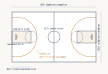
An NFHS regulation high school court is 84 feet long and 50 feet wide, measured to the inside edge of the boundary lines. That length is the one number separating the high school game from the levels above it. College and the NBA both play on 94, with the same 50-foot width.
The Boundary Lines
Every line on the floor is 2 inches wide, and the boundary lines are not part of the playing court. That detail decides calls, so we start our pre-game there, the same way we do with the rest of the rules. A player touching any part of the sideline is out of bounds. There is no "on the line" in basketball the way there is in tennis.
- Length: 84, baseline to baseline.
- Width: 50, sideline to sideline.
- Line width: 2 inches, and the line belongs to the out-of-bounds area.
- Backboard overhang: 4, measured inward from the baseline.
The Lane, Free-Throw Line And Circles
The lane — the paint, the key — is 12 feet wide and runs 19 feet from the baseline to the free-throw line. We find that second figure is the one people get wrong, because the number usually quoted is a different measurement: the free-throw line sits 15 from the face of the backboard, and the backboard hangs 4 inside the baseline. Add the 4 to the 15 and you have the 19.
- Lane width: 12, marked with lane spaces for rebounders — which is where most rebounding fouls get decided.
- Baseline to free-throw line: 19.
- Backboard to free-throw line: 15.
- Free-throw circle: 12 across, centred on the middle of the line. What happens when a shooter has to reset on a free throw is a rule question, not a spec one.
- Centre circle: also 12 across, at mid-court.
The two circles being identical is worth knowing, because if you can remember one of them you already have the other.
The Three-Point Arc
The high school three-point line is an arc 19 feet 9 inches from a point directly beneath the centre of the basket, extended straight to the baseline. The basket centre sits 5¼ inside the baseline, so the arc reaches 25 from the baseline at its deepest and meets the baseline about six in from each sideline.
That same arc is what NCAA women's basketball uses. NCAA men and the NBA shoot from further out, which is why a gym hosting both will carry two arcs painted in different colours.
The Line, Not The Distance
For us the line matters more than the distance. The shooter's feet must be completely behind the arc at the moment of release. A toe on the line makes it a two-point attempt, and we judge the feet at the instant of release rather than where the shooter comes down, the same timing that governs last-second shot mechanics — the same principle that governs a traveling violation, where what matters is the moment the pivot foot moves.
Backboard, Rim And Surrounding Space
The backboard measures 72 by 42 inches with the rim 10 feet above the floor and an inside diameter of 18. A fan-shaped backboard, still legal in older gyms, is smaller at 54 by 35 inches.
The court also needs room around it. NFHS asks for at least 3 of unobstructed space outside the boundary lines and recommends 10 where the building allows. In a tight gym that 3-foot minimum is often what limits how big a court can be, and it changes where a crew can stand under three-person mechanics, which is why you will still find older buildings playing on a shortened floor.
High School Against College And The NBA
| Measurement (feet) | High school | College | NBA |
|---|---|---|---|
| Length | 84 | 94 | 94 |
| Width | 50 | 50 | 50 |
| Three-point arc | 19.75 | 22.15 (men) | 23.75 |
| Lane width | 12 | 12 | 16 |
| Free-throw line | 15 | 15 | 15 |
| Rim height | 10 | 10 | 10 |
Three things never change with the level: the width, the free-throw distance and the rim height.
When A Court Is Smaller Than Regulation
Yes, and plenty are. NFHS permits a reduced court where a facility cannot take the full floor, and a common allowance trims up to 4 off the width and 10 off the length. A 74 by 46 floor is legal. It is also why we measure a gym our crew has not worked before, and why you should too. If you want to test how well you know the rest of the floor, our rules quizzes are a reasonable place to start. The lane, the arc and the free-throw distance are fixed, but the space behind the baseline may not be what our crew is used to.
The NFHS Baseline And State Variations
All of the above is the NFHS baseline. Individual state associations can and do adopt variations on top of it, and we would not rely on any figure here for a game we were actually working. If you are officiating, check your own state association's published rules first. They override anything you read here.
How long is a high school basketball court?
84 feet from baseline to baseline. College and NBA courts are 94.
How far is the three-point line in high school basketball?
19 feet 9 inches from a point directly beneath the centre of the basket, extended to the baseline.